
The Italian Fiscal Code (Codice Fiscale) is the Italian equivalent of the U.S. Social Security Number. For any individual intending to purchase Italian real estate (or rent an apartment, obtain a mortgage, pay taxes, sign a contract, etc.), these are 16 crucial characters that dictate your ability to get what you want.
What is a Codice Fiscale
The codice fiscale is a 16-character code which is assigned to every Italian citizen or resident and combines an individual’s date and place of birth, gender, and full name. The two documents that constitute proof of having a codice fiscale are a green card issued by the Italian Ministry of Finance and the Italian National Health Card (Tessera Sanitaria). If you do not reside in Italy, however, you will be issued a piece of paper rather than a physical card.
Fig. 1: Example of a Codice Fiscale
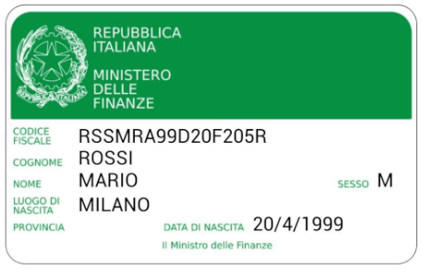
Fig. 2: Example of a Tessera Sanitaria

Getting a Codice Fiscale
The Codice Fiscale is automatically assigned to every Italian citizen who is born in Italy and is registered at the Registry Office of an Italian municipality. Individuals who were not born in Italy but reside there can apply for the code at any Italian Revenue Service (Agenzia delle Entrate) office by providing a valid copy of their ID.
Individuals who do not reside in Italy may be assigned a Codice Fiscale by their local Italian Consulate. The Italian Consulate usually requires the applicant to mail a form with the applicant’s personal information and a copy of their ID.
Individuals who are not citizens and do not reside in Italy may still be assigned a codice fiscale, but only in specific situations. The code can only be issued under these circumstances when it is necessary fulfill a specific administrative or legal procedure in Italy, and cannot be issued for unspecified or future needs. Additionally, the Italian consulate will need to verify and confirm the request, which might take over 30 business days. A more efficient way of getting the code as a non-resident is to delegate an Italian professional as your representative to request the code on your behalf at a local office of the Agenzia delle Entrate.
Connection to the Real Estate Purchase Process
The Codice Fiscale is required in order to purchase or rent a property, obtain a mortgage, pay taxes or sign a contract. Hence, if you are interested in buying Italian real estate, the ‘fiscal code’ is one of the first things you will need to secure. It is also necessary in order to complete various steps of the purchase process, from the preliminary agreement (contratto preliminare) to the final deed of sale (rogito).
We would like to stress that having a codice fiscale does in no way imply having to pay taxes in Italy. You will have to pay income taxes in Italy only if that is where you reside and/or earn a taxable income. In case you decide to purchase Italian real estate, you will have to pay taxes on the transaction (usually between 2% and 4% of the transaction value) and annual real estate taxes afterwards.